
The Iron Man Who Survived Footballs, Cricket Balls, the Japanese, and was saved by a Dutch Economist
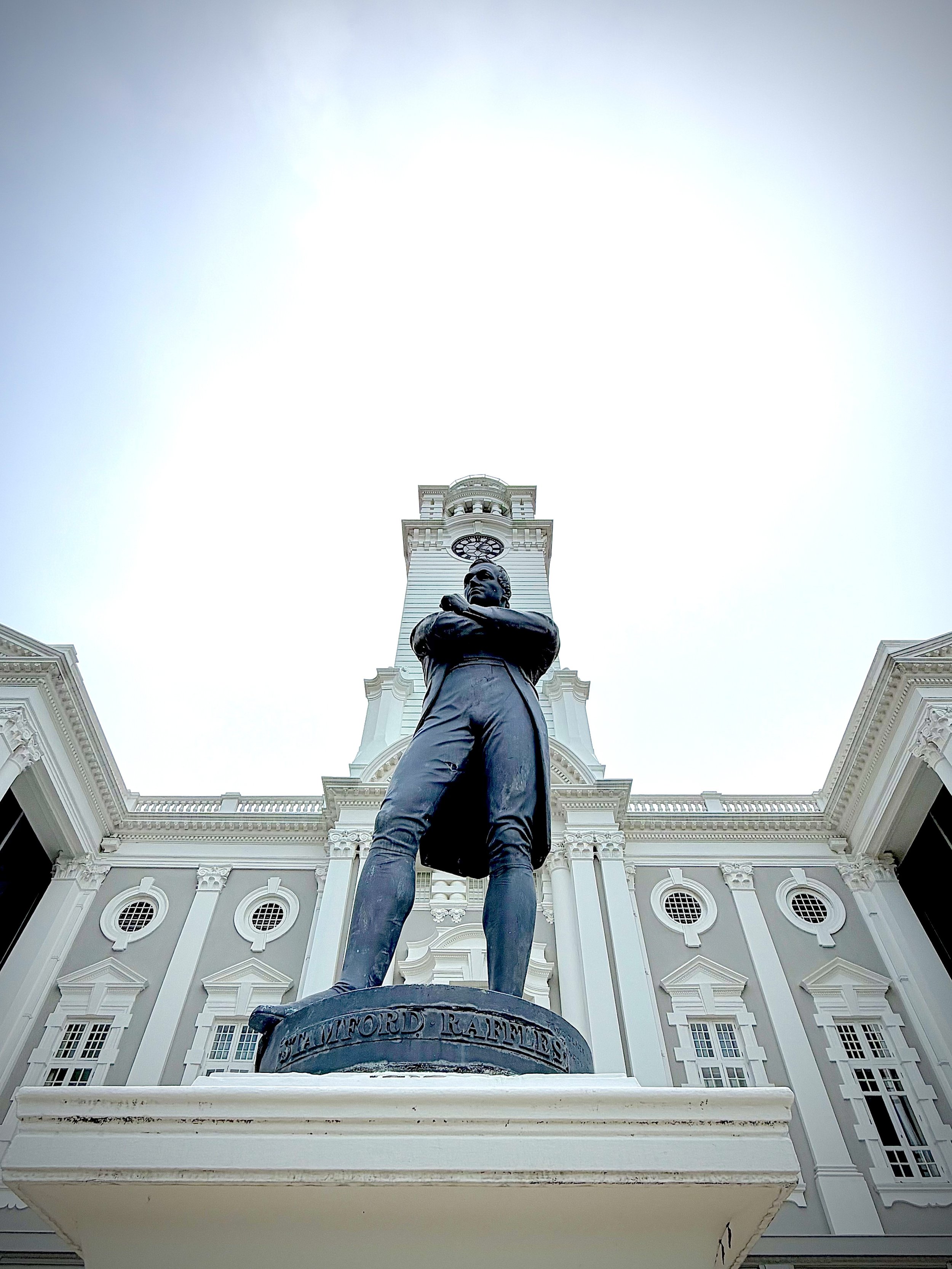
The story of Raffles' two statues is really the story of Singapore itself — colonial ambition, wartime survival, Cold War pragmatism, and a man who died sixty years before anyone thought to immortalise him in bronze.
Here is a fact that should give you pause the next time you walk past the bronze statue of Raffles outside the Victoria Concert Hall: the man it depicts died in 1826 — and nobody thought to commemorate him in bronze until sixty-one years later. For most of the nineteenth century, Sir Thomas Stamford Raffles was largely forgotten in the very city he had founded. No statue. No grand memorial. His name had been quietly attached to a lighthouse and a library, but the man himself had faded from view, buried under the relentless forward momentum of the colony he had planted on a swampy island at the tip of the Malay Peninsula. Then, in the 1880s, a newspaper decided to revive him — and everything changed.
What followed was one of the stranger odysseys in Singapore's civic history: a statue of bronze and a statue of polymarble, separated by a ten-minute walk and nearly a century of turbulence, each carrying the same crossed-arm pose, the same air of imperial self-assurance — and together forming a kind of dual biography of a city that has never quite been able to decide what it thinks of its founder.
The Man Who Made the Iron Man
The bronze statue was the work of Thomas Woolner (1825–1892), and if that name means nothing to you, consider his company: Woolner was one of the founding members of the Pre-Raphaelite Brotherhood, the revolutionary Victorian art movement that counted Millais, Holman Hunt, and Rossetti among its ranks. He was a sculptor and a poet, equally comfortable shaping bronze as writing verse, and by the 1880s he was one of the most sought-after public sculptors in the British Empire — the man behind the Captain Cook statue in Sydney and the Lord Palmerston in London, among many others.
There was, however, a significant problem with the commission: Raffles had been dead for sixty years, which meant Woolner had never seen him. Instead, he worked from existing portraits, and it is thought he modelled the Singapore statue primarily after earlier works by Francis Chantrey, who had sculpted Raffles from life. The eight-foot-tall bronze figure he produced depicted Raffles in civilian dress — arms folded, weight on one leg, gazing with that famous aura of quiet assurance — and at the base, Woolner added a small, almost invisible detail: a carved map of the Straits of Malacca, with Raffles' foot resting upon it, symbolising his planting of the British flag on these shores. The choice of civilian clothes was itself a quiet statement: this was a man of commerce and vision, not a soldier.
Two Raffles — Side by Side
The bronze original: 8 feet tall, cast by Pre-Raphaelite sculptor Thomas Woolner, unveiled 1887 at the Padang, now at Empress Place opposite Victoria Concert Hall
The polymarble replica: unveiled 1972 at Raffles' Landing Site, North Boat Quay — cast from plaster moulds taken from the 1887 original; white in colour, on a tall concrete pedestal
Distance between them: roughly 500 metres — a 10-minute walk along the Singapore River
Both statues depict the same pose: arms folded, weight on left leg, an expression of measured confidence
Both have been moved, hidden, debated, and survived attempts to be destroyed or removed
Football, Footnotes, and the Padang Years
On 27 June 1887 — Queen Victoria's Golden Jubilee Day — Governor Sir Frederick Weld unveiled the new statue at the Padang, Singapore's great open ceremonial field. The choice of occasion was telling: Raffles was being consciously recast as an imperial hero, a man whose vision had extended the Queen's dominions into the Far East. Before the grand opening, Inspector of Schools A.M. Skinner had held a competition among schoolboys for the best inscription to accompany the statue. The colonial establishment was not merely unveiling a piece of art — it was constructing a legend.
Reality, as usual, was rather less dignified. The statue's location at the Padang meant it stood in the middle of one of Singapore's most popular sporting grounds. It was routinely struck by errant footballs and cricket balls during matches. Spectators at the Padang treated its pedestal as a grandstand, climbing up for a better view of the game. The orang besi — iron man, as the locals nicknamed the blackened bronze figure — was being sat on, kicked at, and generally treated as part of the furniture. The colonial authorities were not amused. A more dignified location was clearly required.
They also had to clear the site of its previous occupant. The pedestal on which Raffles now stood had previously held an elephant statue, placed there in 1871 to commemorate a visit by King Chulalongkorn of Thailand. The elephant was quietly moved on. The Iron Man took his place.
The Centenary, the Colonnade, and the Clock Tower
The statue's rehabilitation came in 1919, on the centenary of Raffles' landing. Singapore was in a celebratory mood — a hundred years of colonial prosperity, rubber wealth, and the growth of one of the great ports of Asia — and Governor Sir Arthur Young oversaw the statue's relocation to a site in front of the Victoria Memorial Hall on 6 February 1919, marking exactly one hundred years since Raffles had first come ashore.
The new setting was magnificent. A semi-circular colonnade of the Italian Doric order was constructed to frame the statue. A marble-lined pool with fountain jets sat in front of it. Two rows of flower vases added colour to the classical composition. Most significantly, the statue was positioned with exquisite precision: it faced the mouth of the Singapore River, the supposed site of Raffles' landing, and was aligned axially with the centre of the clock tower of the Victoria Memorial Hall rising behind it. The effect — bronze man, fountain, colonnade, clock tower — was one of theatrical imperial grandeur. Raffles had been given his monument. At last, the orang besi had earned some dignity.
"To pretend that Raffles did not found Singapore would be the first sign of a dishonest society."— S. Rajaratnam, Singapore's first Foreign Minister, 1969
The Japanese and the Museum Storeroom
On 11 September 1942 — seven months after Singapore fell to the Japanese and was renamed Syonan-to, "Light of the South" — the bronze statue of Raffles was removed from Empress Place and taken to the Syonan Museum, the former Raffles Library and Museum now commandeered for Japanese purposes. The colonnade remained standing. The fountain and flower vases were left in place.
The rumours circulated quickly through the occupied city: the Japanese were planning to melt the statue for bronze. It was wartime, metal was scarce, and the symbolic value of destroying the effigy of Singapore's British founder would not have been lost on the occupiers. In the end, the melting never happened. Whether this was oversight, indifference, or a calculated decision remains unclear. The statue sat in storage for three years.
When the Japanese surrendered in 1945, the statue survived. But its beautiful setting did not. The colonnade had been damaged by bombing during the invasion and was found to be beyond repair when the British returned. Governor Sir Franklin Grimson reinstalled the bronze at Empress Place in July 1946 — but without the colonnade, without the fountain, without the flower vases, which were gone for good. The Doric splendour of 1919 was reduced to a statue on a pedestal. It has stood that way ever since.
1826
Raffles dies in London, aged 44. Singapore largely forgets him for sixty years.
27 June 1887
Bronze statue by Thomas Woolner unveiled at the Padang on Queen Victoria's Golden Jubilee Day. Nicknamed orang besi (iron man). Almost immediately used as a football obstacle and spectator seat.
6 February 1919
Centenary of Raffles' landing. Statue moved to Empress Place in front of Victoria Memorial Hall, framed by an Italian Doric colonnade, fountain, and flower vases.
11 September 1942
Removed to Syonan Museum during the Japanese Occupation. Rumours spread that the bronze will be melted for the war effort. It survives.
July 1946
Reinstalled at Empress Place by Governor Grimson. The colonnade, damaged by bombing, is gone forever.
1961–1965
Post-independence. Some PAP voices favour removing the statue. Dutch economist Albert Winsemius advises Lee Kuan Yew to keep it. It stays.
1972
White polymarble replica unveiled at Raffles' Landing Site on the Singapore River, marking the 153rd anniversary of his arrival.
January 2019
For the Bicentennial, companion statues of Sang Nila Utama, Munshi Abdullah, Tan Tock Seng, and Naraina Pillai are temporarily placed alongside the white Raffles at the landing site.
The Dutchman Who Saved the Iron Man
Here is the most remarkable chapter in this statue's long life — and the one least told. When Singapore achieved independence in 1965, the new People's Action Party government was ideologically hostile to the symbols of British colonialism. The PAP had campaigned as an anti-colonial socialist party. Across the newly decolonising world, statues of European administrators were being toppled, streets were being renamed, and the physical traces of empire were being systematically erased. There were voices within Singapore — including, reportedly, within the PAP itself — who were "all for casting the Raffles statue situated in front of Victoria Memorial Hall into the Singapore River."
The man who saved it was not Singaporean. He was Albert Winsemius, a Dutch economist who had been brought to Singapore in 1961 by the United Nations as an economic consultant. Winsemius gave Lee Kuan Yew famously blunt advice, condensed into two conditions for Singapore's success: eliminate the communists, and do not remove the statue of Stamford Raffles.
The reasoning was pure Cold War calculation. Singapore needed Western capital — American and European investment — to survive. Across the Causeway, Malaysia was battling a Communist insurgency. Across the water, Sukarno's Indonesia was nationalising foreign assets and sending soldiers into confrontation. For Singapore to keep a bronze British colonial prominent in its civic centre was, in Winsemius' reading, a message to Wall Street and the City of London: this new socialist government will not touch your assets. Lee, a deeply practical man, understood immediately. In his memoirs, he described the statue as a "symbol of public acceptance of the legacy of the British and could have a positive effect" on Singapore's future development. The Iron Man stayed. And the investment came.
The White Twin at the River
In 1972, the Singapore Tourist Promotion Board decided that 153 years after Raffles' first landing, the exact spot where he came ashore deserved its own monument. A plaster cast was taken from the original 1887 bronze, and from that cast a polymarble replica was made — same pose, same arms-folded authority, same map at the base, but rendered in white rather than the dark patina of the original. It was placed on the north bank of the Singapore River, on the site traditionally believed to be Raffles' landing point, and unveiled before a public that had grown up knowing only the bronze statue at Empress Place.
The white Raffles became, paradoxically, the more famous of the two. Every tourist arriving in Singapore's civic district photographs it. It stands at the bend of the river with the skyline of the financial district rising behind it — the towers of global capital forming the backdrop to the outstretched arms of the man who, in 1819, saw the commercial potential of this malarial estuary. The symbolism is almost too neat, yet the city wears it without irony.
There is, however, a twist: nobody is entirely certain Raffles landed here. The north bank of the Singapore River is tradition, not confirmed fact. An alternative account — derived from the Cho Clan Archives — holds that Raffles' ship carpenter, Chow Ah Chi, led the landing party ashore near the mouth of the Rochor River at Kallang, not here at all. The white statue stands on a disputed landing site, on a spot that may be entirely ceremonial, commemorating a moment whose exact geography has been lost to time.
Who Else Belongs Here?
In January 2019, for the Bicentennial celebrations, the government did something quietly radical. Around the white polymarble Raffles at the landing site, four additional statues were temporarily erected: Sang Nila Utama, the Palembang prince who founded Singapura in 1299; Munshi Abdullah, Raffles' secretary and interpreter, the great early Malay literary figure; Tan Tock Seng, the Chinese philanthropist who built the hospital that still bears his name; and Naraina Pillai, the first Indian building contractor, who constructed Sri Mariamman Temple.17 For the first time, the founding of Singapore was represented not as a single man's act of imperial vision, but as a convergence of peoples, communities, and centuries.
The companion statues were temporary. They came down. Raffles remained, as he always has.
Walk the five hundred metres between the two statues sometime — from the white figure at the river's edge to the dark bronze in the shadow of the clock tower — and you are walking through nearly two centuries of Singapore's complicated relationship with its own origins: the colonial myth, the wartime crisis, the Cold War calculation, the post-independence anxiety, and the ongoing, unresolved question of what a city owes to the man who put it on the map — and what it owes to all the people he never thought to mention.
The Iron Man is still watching. Both of him.
Sources & Further Reading
1. Project MUSE, "Appropriating the Founder: Raffles and Modern Singapore," 2023 — Woolner as Pre-Raphaelite Brotherhood founding member.
2. NLB Infopedia, "Statue of Stamford Raffles" — Woolner modelled after Francis Chantrey's works; NLB Singapore.
3. NLB Infopedia, ibid.; New Naratif, "Raffles Must Fall?" — the map / Straits of Malacca detail at the base of the statue.
4. BiblioAsia, NLB, "Raffles Displaced," Jan–Mar 2021 — the schoolboy inscription competition and the 1887 unveiling context.
5. NLB Singapore, "Statue of Stamford Raffles"; Mothership.SG, "Raffles statue at Empress Place unveiled 130 years ago," 2017.
6. NLB Singapore, "Statue of Stamford Raffles" — the elephant statue and King Chulalongkorn.
7. Straits Times, "Centenary of Singapore," 7 February 1919, as cited in NLB Infopedia.
8. NLB Singapore, ibid. — the Italian Doric colonnade, pool, and axial alignment with the clock tower.
9. Syonan Times, "Statue of Founder removed to Museum," 13 September 1942; NLB Infopedia.
10. History of Raffles Statues in Singapore, johorkaki.blogspot.com, 2020; NLB Infopedia.
11. Sunday Tribune, "Stamford Raffles Moves Back," 7 July 1946; NLB Infopedia.
12. S. Rajaratnam, speech at Shangri-La Hotel seminar, 28 April 1984, National Archives of Singapore, as cited in Contested Histories Occasional Paper, July 2020.
13. BiblioAsia, "Raffles Displaced," 2021; The Straits Times, "Singapore Is Indebted to Winsemius: SM," 10 December 1996.
14. Lee Kuan Yew, Straits Times, 10 December 1996, as cited in NLB Infopedia, "Statue of Stamford Raffles."
15. Roots.gov.sg, "Statue of Sir Stamford Raffles in front of the Victoria Memorial Hall"; Asian Art Platform, restoration notes on the polymarble statue.
16. Wikipedia, "Raffles' Landing Site" — the Cho Clan Archives alternative account.
17. Channel NewsAsia, "Sang Nila Utama, Pioneers Join Stamford Raffles along Singapore River," 4 January 2019.
