
Tackling the City by the Horns.
There is a version of Singapore that no longer exists—one you will not find in glossy brochures or MRT maps. It is a Singapore of hooves on gravel, of lowing cattle at dawn, of buffalo carts creaking through muddy streets. Before the island became a city of glass and algorithms, it was, quite literally, powered by animals.
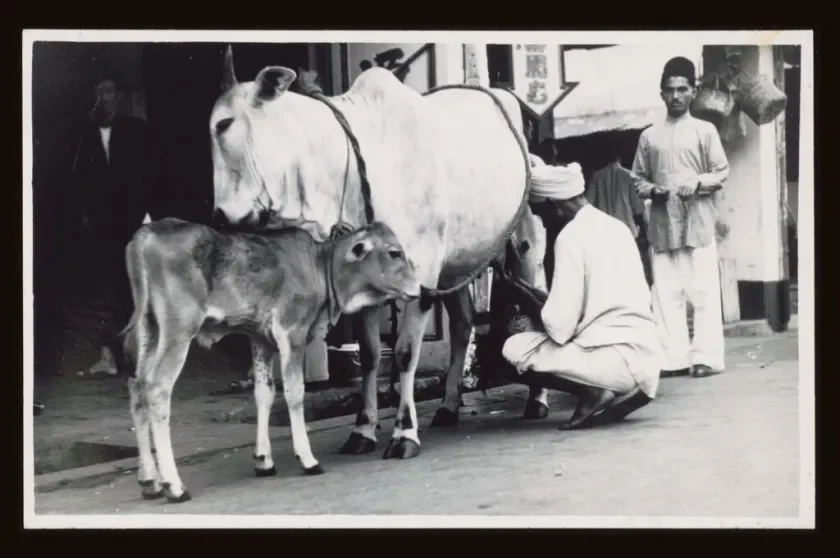
Milkman milking the cows at people’s doorstep.
To understand that forgotten Singapore is to understand cattle—not as a side story, but as a central force in how the island moved, ate, traded, and lived.
The City That Moved on Hooves
In the early 19th century, long before cars and buses, Singapore ran on muscle—human and animal. Among the most important of these were bullocks and buffaloes. The humble bullock cart was not a quaint relic; it was infrastructure.
As the National Library Board notes, bullock carts were “primary forms of transportation” alongside trams and rickshaws, moving goods across the port and construction sites and sustaining the young colony’s economy.
They hauled bricks to build the city. They transported cargo at Boat Quay. They even flattened the Padang’s grass and mowed lawns at the racecourse.
But perhaps their most intimate role was in domestic life.
Before piped water, there was the daily ritual of water collection. And this is where cattle quite literally gave Singapore one of its most iconic place names.
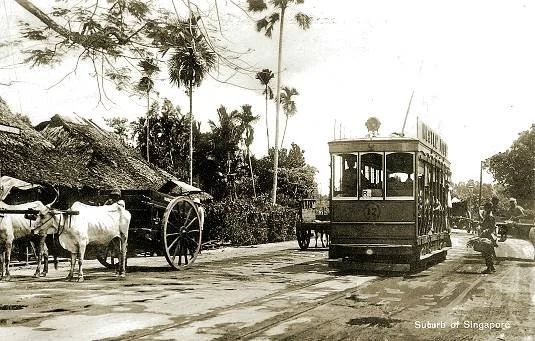
A bullock cart with the Singapore electric tram
Kreta Ayer: A Name Written in Water and Animal Labour
The name Kreta Ayer—today synonymous with Chinatown—translates to “water cart.” But that translation misses the texture of the past.
These were not abstract carts. They were bullock carts, creaking under the weight of water barrels, making their slow way from wells near Ann Siang Hill into the dense Chinese settlement.
Some have wondered why unlike almost any Chinatown anywhere which is usually called Tángrénjiē or “Tang People Street“ - In Singapore Chinatown in the Chinese dialects is refred to as Niu Che Shui—“bullock water-cart.”
This was not poetic naming. It was literal.
Every drop of water consumed in early Chinatown was hauled by cattle. The carts did more than transport water—they shaped the rhythms of life. For more than a century growing up in most parts of Singapore, the sound of wheels and hooves was as constant as the clatter of chopsticks.
Even the dust of the streets bore their imprint. As the carts passed, water spilled and dampened the roads, keeping down dust in an otherwise dry and congested district.
In this way, cattle did not just sustain the city—they softened it.
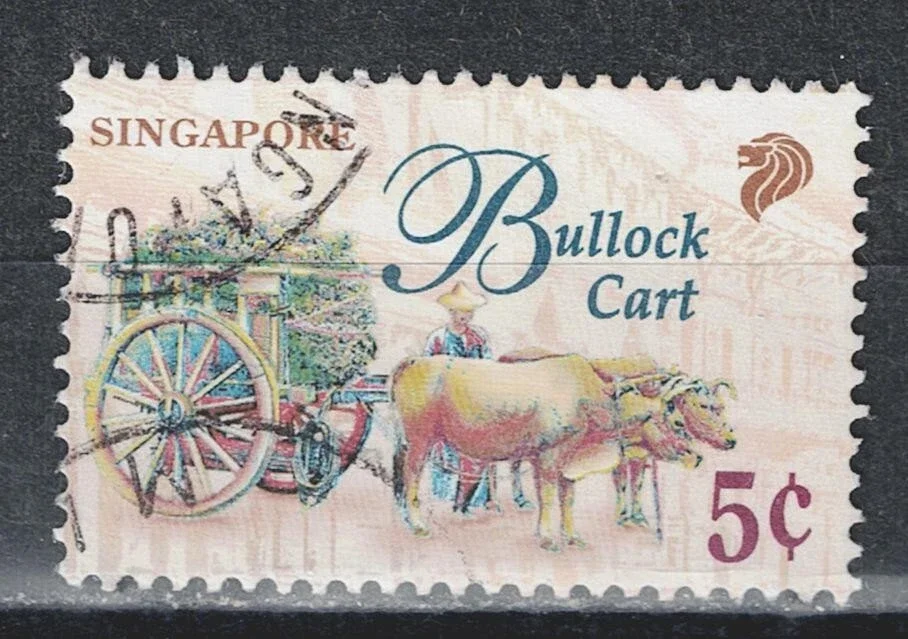
A celebration of cattle in our stamps
Milk, Meat, and the Everyday Economy
Cattle were not just engines of movement. They were also sources of nourishment.
As early as 1831, cattle and beef were being imported into Singapore, feeding a growing, multicultural population.
Beef entered local cuisines—from Hainanese beef noodles to Malay rendang—embedding itself into the culinary DNA of the island.
But beyond beef, there was milk.
Across colonial Singapore, cows, goats, and buffaloes supplied fresh milk in an era before refrigeration. Milk sellers—often from Indian communities—delivered it door-to-door, sometimes directly from animal to customer. It was an economy built on proximity and trust.
Certain streets in Chinatown (Cross Street for example) even became associated with dairy distribution, informally earning reputations as “milk streets,” where cattle were kept or milk was traded. These were spaces where agriculture and urban life overlapped in ways that feel almost unimaginable today.
Little India and the World of Cattle
If Chinatown’s identity was shaped by water carts, then Little India was shaped by cattle themselves.
The very name Kerbau Road—kerbau meaning “buffalo” in Malay—tells a story.
This area, around present-day Tekka, was once the centre of Singapore’s cattle trade. Buffaloes were kept, traded, and slaughtered here. The landscape would have been filled with the smell of hay and livestock, a far cry from today’s vibrant retail streets.
A statue near Buffalo Road today commemorates this past—a turbaned driver guiding his bullock cart, a frozen echo of a vanished world.
By the early 20th century, the cattle trade here had grown significant enough to produce figures like Moona Kader Sultan, known as the “Cattle King,” who dominated livestock imports and who ““bought, bullied and buried rivals to his Straits Cattle Trading Company” and created his fortune from the trade. But that’s another whole Blog Post!
The point is that cattle were not peripheral. They were big business. They were [art of the living breathing history of the city.
The Dhobis and the Ecology of Labour
Another community deeply intertwined with cattle were the dhobis—the traditional washermen of colonial Singapore.
While not always directly using cattle, their work existed within the same ecological system of labour that cattle enabled. Water transported by bullock carts fed washing areas. Buffaloes and oxen sometimes helped in hauling heavy loads of laundry or equipment.
The dhoby grounds—open fields where clothes were washed and dried—depended on a steady water supply. So did the buffalos and the cows. And they both - such as on the banks of the Sungei Rochor at what is now Little India shared the water and the space. Without the cattle-driven water economy, such labour would have been far more difficult.
In this way, cattle quietly underpinned entire professions.
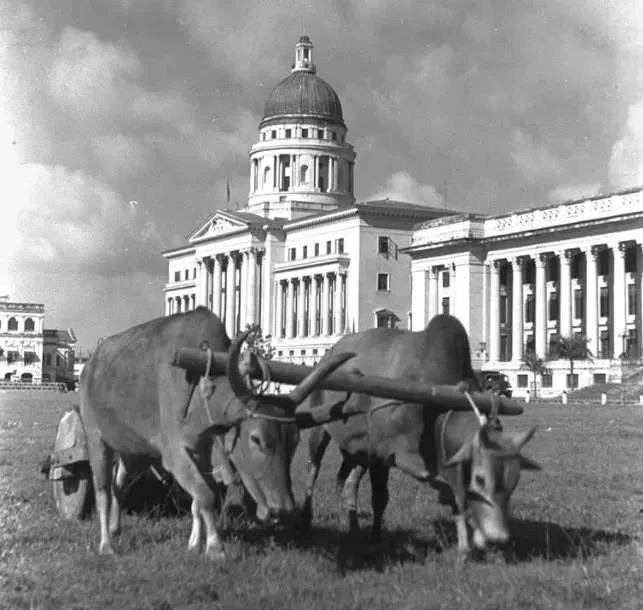
Bullocks grazing on the Padang.
A Multispecies City
What emerges from these fragments is a portrait of Singapore as a multispecies city.
Cattle ploughed through mud and dust. Goats bleated in back alleys. Buffaloes stood tethered in what are now prime urban districts. Chickens roamed the roads. Horse carriages clattered their way through the streets. Pigs oinked their way through the lanes of Punggol and Choa Chu Kang. The boundaries between rural and urban were porous.
Even the social fabric reflected this. Bullock cart drivers were often Indian migrants. Chinese residents relied on their services. Malay terms like kereta air became embedded in everyday speech.
The city was not just multicultural—it was interdependent across species and communities.
The Beginning of the End
But this world was already beginning to disappear by the early 20th century.
Motor vehicles arrived. Roads improved. Urban planning became more rigid. The slow, organic rhythms of animal-powered transport began to give way to speed and efficiency.
The demand for bullock carts declined steadily, and by the mid-20th century, they had “virtually disappeared.”
Yet, even as they faded, cattle remained present—sometimes uncomfortably so.
Lee Kuan Yew and the Problem of Cattle
By the 1950s and 60s, Singapore was in transition—from colony to modern nation.
And in that transition, free-roaming cattle became a problem.
They wandered onto roads, caused traffic disruptions, and posed safety risks in an increasingly motorised city. They were remnants of an older Singapore that no longer fit the vision of a modern, efficient state.
Lee Kuan Yew understood this tension intimately.
He was not indifferent to cattle. In fact, accounts suggest he had a personal familiarity with them, having grown up in a Singapore where they were part of everyday life. But as Prime Minister, he prioritised order, safety, and modernisation.
It is said anecdotally that the last straw - or blade of grass anyway - was when LKY was looking out of his office in the Old Parliament House and saw a bunch of cows feeding at the Padang. In his memoirs he writes, “One morning in November 1964 I looked across the Padang from my office window at City Hall to see several cows grazing on the Esplanade! A few days later a lawyer driving on a main road just outside the city hit a cow and died.”
The solution was decisive and very typical - free-roaming cattle were banned. I quote LKY again, "We gave owners of cows and goats a grace period until 31 January 1965 after which all such stray animals would be taken to the abattoir and the meat given to welfare homes. By December 1965 we had seized and slaughtered 53 cows. Very quickly, all cattle and goats were back in their sheds" .
”This was not just a regulatory change. It was symbolic.
It marked the end of a way of life.
The kampong, with its animals and informal systems, gave way to the planned city. The unpredictability of cattle on roads was replaced by the precision of traffic lights and expressways.
In Lee’s Singapore, just as poetry was an unaffordable luxury, there was apparently no room for wandering cows.
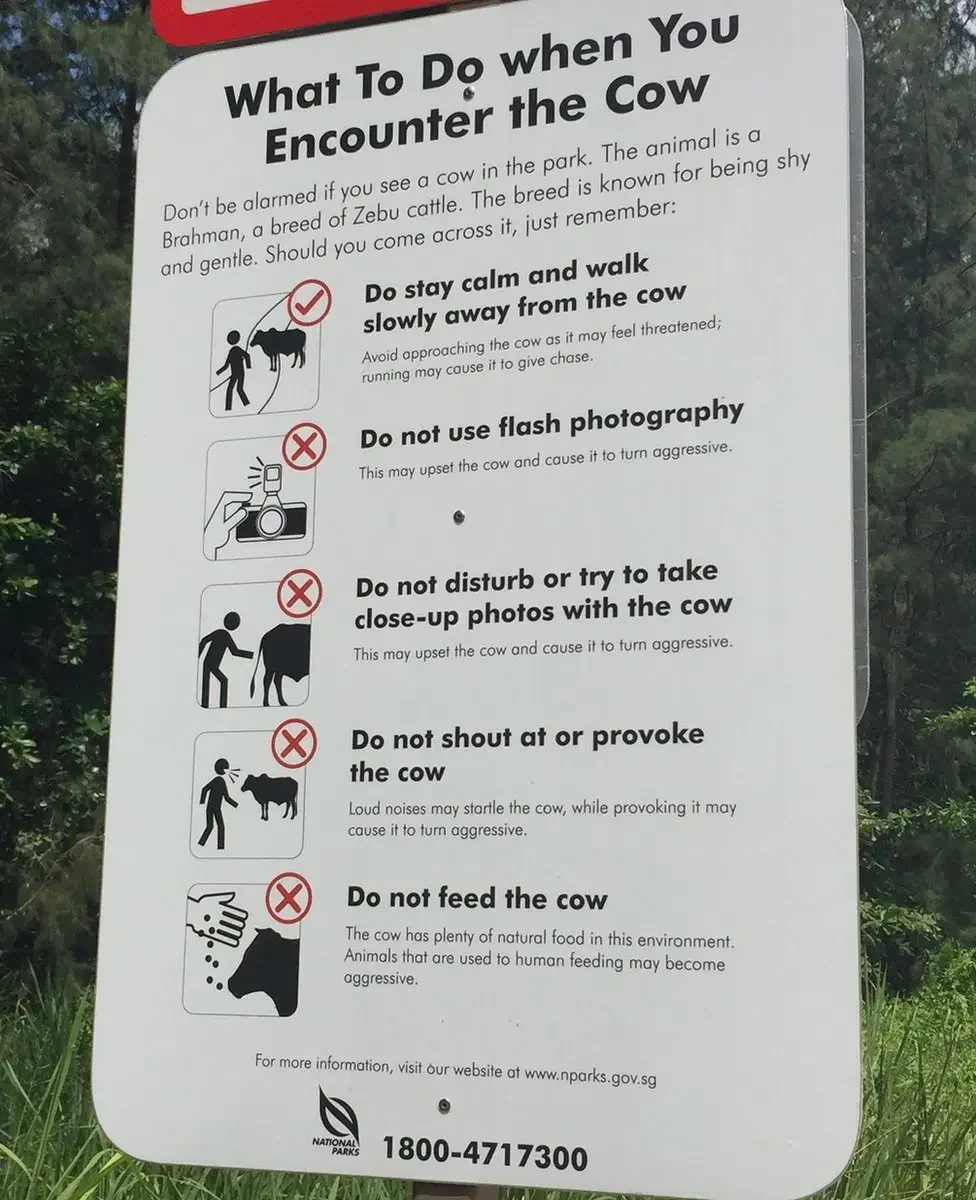
But it is interesting that as was widely reported including in the BBC, the last free roaming cow dies in Coney Island in 2016. It was a stray with no one aware on how he ended up there. But pass away from old age he did, not walking after a routine examination. There even was a sign on the island to tell people how to act when they saw the cow!
What We Lost (and What We Gained)
It is easy to romanticise this past—to imagine a gentler, slower Singapore.
But that would be incomplete.
The cattle economy was also one of hardship. Bullock cart drivers endured long hours and physical strain. Urban sanitation was poor. Overcrowding and disease were real problems in districts like Kreta Ayer.
Modernisation brought undeniable benefits: clean water, efficient transport, safer streets.
And yet, something intangible was lost.
The presence of animals in daily life created a different relationship with the city—one that was tactile, immediate, and grounded in the rhythms of nature.
Today, cattle survive in Singapore mostly as memory: in street names like Kerbau Road, in statues, in the etymology of Kreta Ayer.
They are ghosts embedded in the urban landscape.
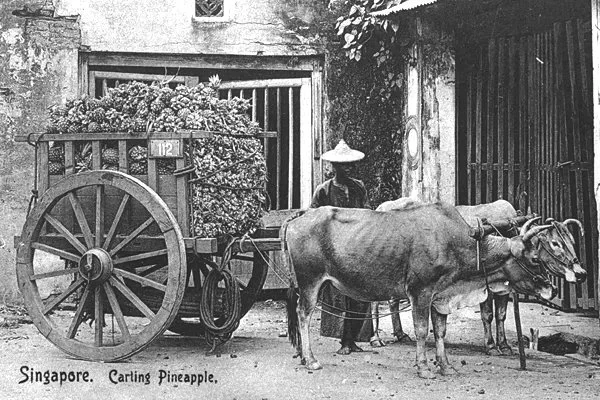
A Bullock Cart laden with Pineapples.
Reading the City Differently
Walk through Chinatown today and you will see shophouses, curated heritage trails, and tourists photographing lanterns.
But if you look closely—if you read the names, trace the histories—you might hear something else.
The creak of wooden wheels.
The low grunt of a bullock.
The splash of water on dry earth.
Singapore did not simply rise from the sea into modernity. It was carried there—slowly, stubbornly—on the backs of animals.
And in remembering cattle, we remember a different kind of city. One that was messier, yes. But also more alive.
