
The Building That’s Also The Architect’s Signature - in Chinese.
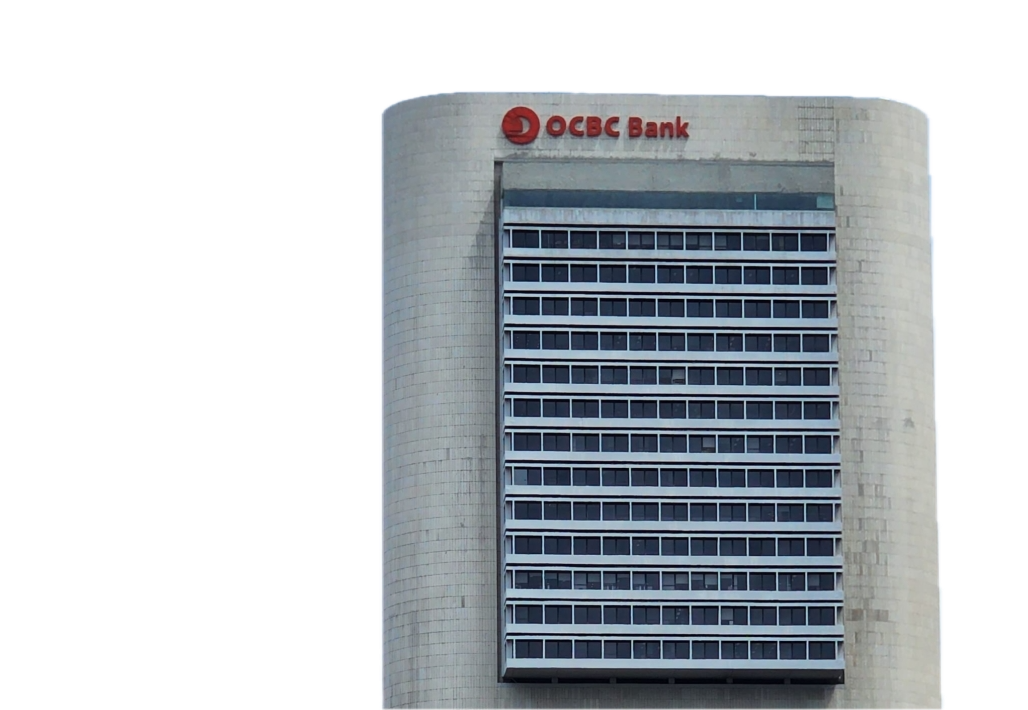
I.M. Pei didn't just build what was Singapore's tallest skyscraper in 1976 — he may have hidden his own Chinese name in it. And that's only the beginning of the story.
Picture Singapore in 1970. The tallest building on the island is eight storeys. The skyline is a gentle rumple of shophouses, colonial offices, and the odd mid-rise poking above the trees. Then a Chinese-American architect named Ieoh Ming Pei steps off a plane, shakes hands with a banker named Tan Chin Tuan, and begins drawing something that would change the profile of the city forever. Six years later, at 65 Chulia Street, a 52-storey brutalist titan pierces the sky above the Singapore River — the tallest building in all of Asia outside of Japan. And if you know where to look, it is also, quite possibly, a love letter written in Chinese.
This is the story of OCBC Centre: a building that arrived like a declaration, was engineered through a brilliant act of deception, carries a myth inside its very bones — and, in 2024, became home to Singapore's rarest breeding bird. It is the most quietly astonishing building in the city, and most people walk past it without a second glance.
What Stood Here Before
There has been a bank on this site since 1932, when the Oversea-Chinese Banking Corporation first threw open its doors with an authorised capital of $40 million and planted its flag in a six-storey building called the China Building, designed by the firm Keys and Dowdeswell in an ornate Peking style — all decorative eaves and Chinese signifiers meant to project power and tradition to a community of merchants who had crossed oceans to build their fortunes in the Straits Settlements.
The China Building had its own quiet glamour. In the 1950s and early 1960s, OCBC chairman Lee Kong Chian — one of the most powerful businessmen in Southeast Asia, the rubber and pineapple magnate who would later endow the Lee Kong Chian Natural History Museum — hosted regular lunches at the Garden Club on the building's top floor. The who's who of Chinese business in Singapore would gather there to talk commerce and politics, in a room that smelled of ambition. For nearly forty years, the China Building was the house of money in Singapore.
By the late 1960s, though, OCBC had simply outgrown it. The bank bought up surrounding land and shophouses. They needed something bigger, something bolder. And Tan Chin Tuan, OCBC's president, had exactly the right man in mind — a family friend he happened to know personally. In commissioning I.M. Pei & Partners, he made I.M. Pei the very first foreign architect to be formally invited to design a building in Singapore. That single handshake opened a door that has never closed — every trophy project in the city built by foreign firms since then can trace its lineage to this moment.
The Building at a Glance
Address: 65 Chulia Street, Singapore — overlooking the Singapore River at the head of the Golden Shoe financial district
Height: 197.7 metres (649 feet), 52 storeys
Cost: S$100 million — the most expensive urban renewal project in Singapore at the time
Completed: 1 October 1976, after just under two years of construction
Record: Tallest building in Southeast Asia and tallest in Asia outside Japan upon completion
Contractor: Morrison-Knudsen International (USA) and Low Keng Huat Construction (Singapore)
The Great Engineering Trick
Here is the problem Pei faced when he arrived in Singapore in the early 1970s: he had been asked to build a 52-storey skyscraper in a country where the tallest existing building was eight storeys high. There were no contractors with experience building anything remotely that tall. The technical challenge was enormous. The psychological one was arguably worse — how do you convince a building industry that has never gone above eight floors to trust you on fifty-two?
Pei's answer was a piece of architectural genius disguised as simplification. Rather than present Singapore's contractors with a single overwhelming tower, he broke the problem into thirds. The design conceived the building as three separate fifteen-storey structures stacked on top of each other, connected by massive post-tensioned steel transfer girders at the 4th, 20th, and 35th floors. The contractors were not being asked to build the tallest skyscraper in Asia — they were being asked to build a fifteen-storey building, three times, one on top of the other.
The structural core of the building consists of two enormous semi-circular concrete columns — one at each end — which anchor everything and house the building's 27 elevators, staircases, and service utilities. The office floors hang between these cores like the rungs of a ladder, entirely column-free. The result at ground level is a banking hall 175 feet long by 120 feet wide with not a single interior support — a cathedral of commerce, vast and unbroken. The trick worked. The building went up in less than two years. When it opened, it boasted the fastest elevators in the city, travelling at 366 metres per minute.
"Pei determined to build a straightforward expression of structure, simplifying the complex so that the wary contractor was not challenged by Singapore's tallest skyscraper, but three fifteen-story buildings stacked on top of each other."— I.M. Pei Foundation, project documentation
Before construction could begin, OCBC faced its own logistical nightmare: moving decades' worth of enormous bank safes out of the China Building. A young boy named Teo Chee Hean — whose father was then an assistant general manager at the bank — was brought along to witness the event. He watched as cranes arrived, part of the China Building's roof was removed to create clearance, and the massive safes were hoisted up and out into a neighbouring building on Upper Pickering Street. The future Deputy Prime Minister of Singapore was, at that moment, watching Singapore's future being craned into the sky one safe at a time.
The Myth Written Into the Walls
Now we arrive at the part of this story that will rearrange the way you see this building forever. Stand on the opposite bank of the Singapore River, or look at the OCBC Centre from above, and you will notice something odd. The building's profile — those two semi-circular concrete cores flanking a rectangular central block — bears an uncanny resemblance to a Chinese character. Specifically, the character 貝 (bèi), meaning shell or, more historically, currency itself. In ancient Chinese civilisation, shells were the original medium of exchange. "Bei" is the root embedded in dozens of financial and commercial Chinese words to this day.
OCBC is a bank. Its motto is "Solid as a Rock." The character for the ancient currency unit is built into the facade. Coincidence? Perhaps. But then consider this: I.M. Pei's Chinese surname is also 貝 — Pei. The man built a bank and encoded his own family name into its silhouette.
And the rabbit hole goes deeper. According to feng shui analysts who have studied Pei's Singapore work, the OCBC Centre was only the first move in an elaborate urban calligraphy. His second Singapore project, the Swissôtel The Stamford (1986), is said to resemble the character 岳 or 耀 — phonetic echoes of "Ieoh," his given name. His third, The Gateway (1990), with its two dramatically angled towers, reportedly evokes 明 — "Ming," his middle name. Laid out on a map, the three buildings form a sequential line across the city. Whether this was intentional design or the projection of a pattern-hungry culture onto raw concrete, nobody has ever definitively proved — or disproved.
The feng shui reading of the site is equally elaborate. The OCBC Centre is said to sit at a formation known as "Carp Jumping the Dragon Gate" — a classically auspicious positioning in Chinese geomancy, associated with dramatic leaps in fortune and status. For a bank whose founding mythology was built by immigrant Chinese entrepreneurs who had themselves leapt oceans to reach Singapore, the symbolism is almost too perfect.
The Sculptor and Three Trips to England
Pei did not stop at the building itself. He wanted something in the plaza to match — a piece of art powerful enough to hold its own against 198 metres of brutalist concrete. His choice was Henry Moore, the great British sculptor, then in the final years of his career. Pei had seen a 13-inch maquette Moore had made in 1938 — a small reclining bronze figure that had sat largely forgotten for four decades. He wanted Moore to blow it up, to scale that miniature into something monumental.
Moore said no. Pei went back. Moore said no again. Pei made a third trip to Moore's studio in Hertfordshire and, finally, on the third visit, convinced the elderly sculptor to do it.10 The result, installed in the plaza in 1984, is the Large Reclining Figure — a 25-foot-long bronze, the largest walk-through sculpture Henry Moore ever produced, and one of the last works he completed before his death in 1986. It replaced an earlier piece by Singaporean artist Tan Teng Kee, which had stood at the building since its opening. The Moore sits there today in a reflecting pool, organic and sensuous against the hard geometry of the tower above — the breezy feminine counterpoint to all that brutal masculine concrete, as if Pei planned the contrast all along. He probably did.
1932
OCBC founded; headquartered in the China Building at the same Chulia Street site, designed in decorative Peking style by Keys and Dowdeswell.
1968–1970
OCBC buys surrounding land. China Building demolished. Tan Chin Tuan commissions I.M. Pei — the first foreign architect invited to build in Singapore.
1975–1976
Construction by Morrison-Knudsen and Low Keng Huat. Completed in under two years using Pei's three-stacked-towers structural trick.
1 October 1976
Official opening. Southeast Asia's tallest building. Tallest in Asia outside Japan. Singapore's most expensive urban renewal project at S$100 million.
1984
Henry Moore's Large Reclining Figure installed in the plaza — Moore's largest sculpture ever and one of his last works.
April 2024
A pair of peregrine falcons lay eggs in a recess on the 34th floor — Singapore's first recorded nesting pair of the species.
April 2025
Two chicks successfully hatch and fledge — Singapore's first-ever recorded peregrine falcon chicks.
March 2026
Four chicks hatch in the same 34th-floor recess. The building's CCTV livestream of the nest becomes a minor national obsession.
The Falcons on the 34th Floor
If all the above feels like the kind of history that happens once and then calcifies into a plaque, consider what has been unfolding on the building's exterior for the past two years. On the night of January 30, 2024, a visiting ornithologist named Marc Kery from the Swiss Ornithological Institute was walking near the CBD when he spotted a fast-moving silhouette near the OCBC Centre. He returned the next day with binoculars. He was not wrong: a pair of Indo-Pacific peregrine falcons — Falco peregrinus ernesti — had chosen a concrete recess on the building's 34th floor, facing the Singapore River, as their nesting site.
Peregrine falcons are the fastest animals on Earth in a dive. In the wild, they nest on exposed cliff ledges. A 198-metre modernist skyscraper, it turns out, is a reasonable facsimile of a cliff face — good sightlines, unobstructed launch points, and an urban sky full of pigeons. The pair laid eggs that April. The eggs were laid on bare concrete and ultimately abandoned. NParks researchers, working with SUTD engineers, installed a gravel nesting tray in November 2024. By April 2025, two chicks had successfully hatched and fledged — the first recorded peregrine falcon chicks in Singapore's history. In early 2026, the same pair returned and laid four eggs. All four hatched. NParks streamed the nest live from March 5, and the nation watched, rapt, as four downy chicks wobbled at the edge of one of Singapore's most historic buildings.
OCBC's head of communications said at the time: "It is sometimes said that when a bird chooses to nest at your home, it can bring good luck to the owner." The bank — whose motto has always been "Solid as a Rock" — is apparently now also a cliff.
A Building That Is Still Becoming
In early 2025, OCBC announced it was deferring plans to redevelop the Chulia Street complex, citing capital priorities and the difficulty of preserving what has now been designated a historic structure by Singapore's National Heritage Board. The building, in other words, is not going anywhere. It is too important — legally protected, architecturally singular, and embedded in too many layers of history to be quietly demolished and replaced with glass.
And so it stands: a brutalist landmark that carries inside it the story of Singapore's post-independence leap of ambition; the coded signature of a Chinese-American architect who may have written his name across a city in concrete; a Henry Moore that took three trips to England to commission; the memory of a young future Deputy Prime Minister watching bank safes swing through the air on a crane; and, right now, at this very moment, a family of peregrine falcons raising their fourth generation of chicks in a gravel tray on the thirty-fourth floor.
Most people walking along Chulia Street just see a big old building with a funny shape. Now you know better. Look up. The building has been watching you back for fifty years, and it has quite a few things to say — if only you know how to read the character it carved into the Singapore sky.
Sources & Further Reading
1. Nestia, "41-year-old OCBC Centre designed by famed architect I.M. Pei," 2018; Keys & Dowdeswell attribution via OCBC institutional history.
2. OCBC commemorative book, Wind Behind the Sails, as cited in Nestia, 2018.
3. I.M. Pei Foundation, project page: Oversea-Chinese Banking Centre; Site Visits, "Representing the OCBC Centre by I.M. Pei," October 2019.
4. I.M. Pei Foundation, project documentation; also Docomomo Singapore, "OCBC Centre," 2021.
5. Pei Cobb Freed & Partners, project description, pcf-p.com; Docomomo Singapore, "OCBC Centre," 2021.
6. OCBC commemorative book, Wind Behind the Sails, DPM Teo Chee Hean's account, as cited in Nestia, 2018.
7. Way Fengshui Group, "The Complex Relationship between OCBC Building and I.M. Pei," November 2018.
8. Ibid.
9. Ibid.
10. I.M. Pei Foundation, project page; Site Visits, "Representing the OCBC Centre by I.M. Pei," October 2019.
11. Xinhua Feature, "Peregrine falcon family in Singapore's city center," March 16, 2026.
12. NParks, "First record of Peregrine Falcon chicks in Singapore," May 2025; Xinhua, March 2026.
13. Koh Ching Ching, OCBC, quoted in Mothership.SG, "1st record of rare peregrine falcons nesting in S'pore," November 2024.
14. Business Times / citicommercial.com.sg, "Why did OCBC put Chulia Street redevelopment plans on the back burner?," 2025.
